Applications
The details that actually leak on a camper, and what we spec at each one.
The Roof Deck
The field of the roof is rarely where a camper starts leaking, but it is where the coating earns its keep long-term. Hail, tree branches, ponding at the low spot behind the AC shroud, and years of UV all work on the same surface.
A sprayed Alasta Seal deck has no laps and no fasteners. Where a factory EPDM roof has a seam every eight feet and a mechanically-fastened termination bar at the edges, the polyurea deck is one piece from drip rail to drip rail.
Ponding is not a problem. Alasta Seal is a fully adhered, non-breathable membrane — standing water sits on top of it with nowhere to go.
Spec: Alasta Seal at 40–60 mil DFT over 7001 primer, full deck.
Vent, Fan & AC Flanges
This is where campers leak. A roof vent is a box screwed through the roof deck with a bead of lap sealant around the flange, and that sealant is a wear item — it hardens, shrinks, and cracks, usually within three to five years.
The right repair is not more caulk. Cut out the failed sealant, prime the flange and the surrounding deck, and let the membrane self-flash up onto the flange as one continuous piece. Now there is no joint at all.
Same treatment for the AC gasket perimeter, antenna bases, solar mount feet, and any old accessory hole that has been plugged and forgotten.
Spec: 7001 primer on the flange and 6 in. of surrounding deck, Alasta Seal built to 80 mil across the transition.
Front & Rear Cap Seams
The joint where a molded fiberglass cap meets the roof and sidewalls is a compound curve covered by a trim strip and a run of sealant. It flexes every time the unit is towed and it faces directly into wind-driven rain at highway speed.
Because it is two dissimilar materials meeting at a moving joint, it is also the single detail most likely to be leaking on a used camper that looks fine otherwise.
Primed and sprayed, the cap seam becomes part of the same membrane as the roof — no trim strip to lift, no sealant to shrink.
Spec: Alasta Seal at 80 mil across the joint, feathered out 6–8 in. onto both the cap and the roof deck.
Storage Bays & Underbelly
Owners inspect the roof and ignore the bottom half of the unit. Meanwhile the tops of storage bay doors channel water straight into the compartment, and the underbelly takes constant road spray, gravel, and — in the salt states — brine that eats frame rails and outrigger welds.
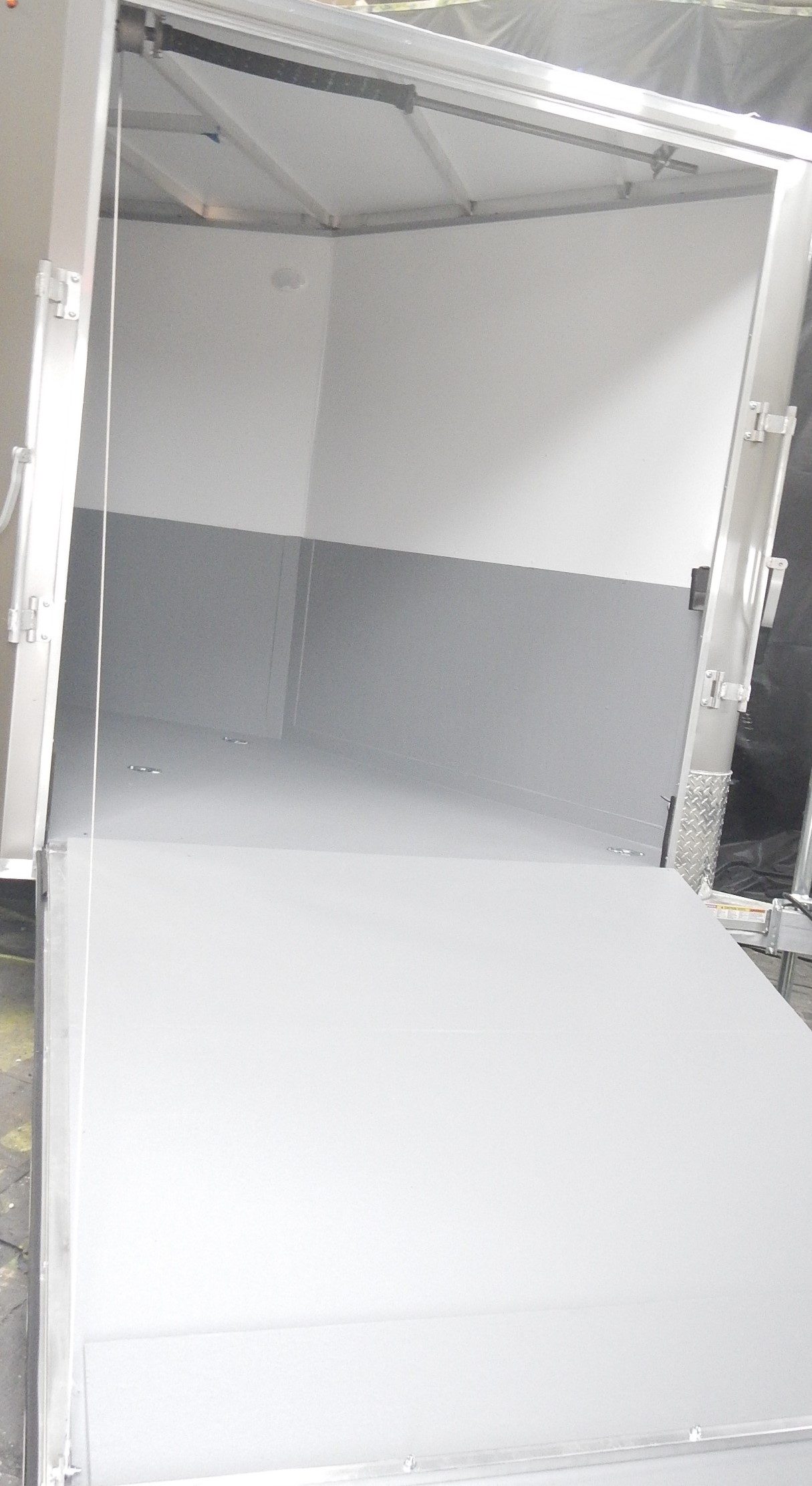
Coating the bay tops, door frames, and compartment floors keeps gear dry and stops the slow rot in the plywood floor above them. Coating the frame and underbelly stops the corrosion nobody looks at until something structural gives.
Spec: Alasta Seal at 30–40 mil on bay interiors and door frames; 40 mil on frame rails, outriggers, and underbelly with 7001 primer over any previously coated or galvanized steel.
Also Regularly Specified For
- Pop-up camper roofs — where the lift mechanism means a heavy rigid coating is not an option
- Teardrop and micro-trailer shells — full-body seal including the galley hatch seam
- Truck camper wings and jack mounts — high-stress attachment points that crack sealant fast
- Slide-out toppers, rails, and wipe seals — the roof detail with the most movement on the unit
- Skylight and roof hatch curbs — sealed to the curb rather than to the plastic dome
- Solar panel and antenna mounting feet — every new roof accessory is a new hole
- Marker light and wiring pass-throughs — small, ignored, and responsible for a surprising share of sidewall rot
- Roof ladder and rack attachment points — through-bolted and flexing
Not Sure Where Yours Is Leaking?
Describe the unit and where you are seeing water and we will tell you where to look first — and whether a whole-envelope seal or a targeted detail is the right scope.
Ask an ApplicatorGet a Camper Waterproofing Quote
Tell us about your project and we will follow up with product details, technical data sheets, and pricing.